The armchair is a wonderful place to be
What have we been up to?
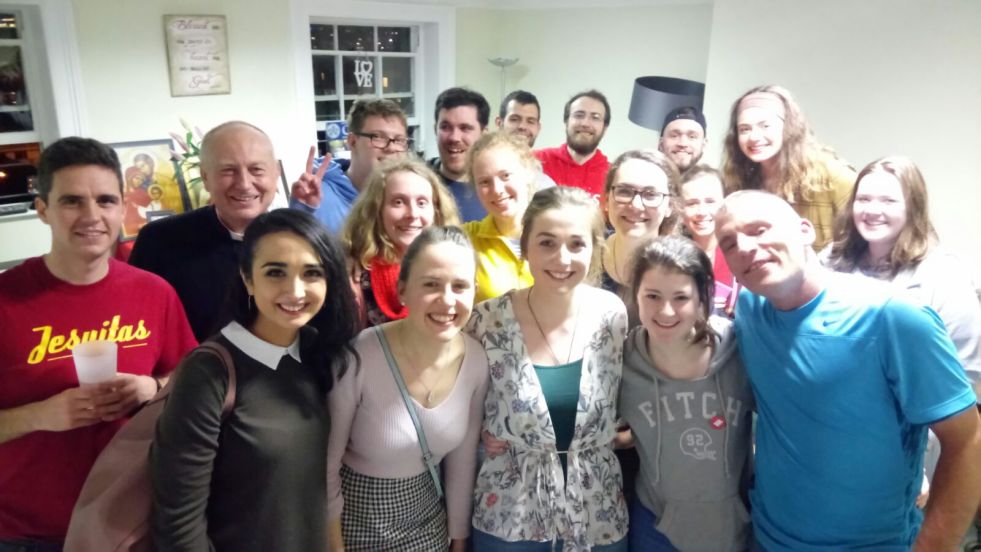
It has been a very busy two weeks for the novitiate. As was mentioned before, Manresa House is an inter-provincial novitiate. As a result, the intake here is from four countries: Ireland, Britain, Flanders, and the Netherlands. During each of the two years, a tour is made of either the Irish Province or the Flemish and Dutch Provinces together. This year, we took the latter. They are both beautiful countries, and it’s always good to hear the Jesuits there speak of their work.
After returning last Monday we got a day to rest and a few of us went to see the new Star Trek film, Into Darkness, on Tuesday evening. It’s a wonderful film of friendship, obedience and good vs. evil. A great review is found here on the British Jesuits online journal, “Thinking Faith”. http://www.thinkingfaith.org/articles/FILM_20130517_3.htm
Writing a blog is fairly easy. You have something to share, you sit, and you write it. Do you want a challenge? Try speaking in public. We’ve just concluded two and a half days of public speaking and presentation skills. It was facilitated by Mary P Casey, a lecturer in public speaking at St. Mary’s College, Oscott (the seminary in the Archdiocese of Birmingham). It’s always a strange experience suddenly to focus on something as ordinary as speaking. You become aware of your voice every time you speak. I’m sure some of you may have had the experience of shaking hands, an unsettled stomach and shaky legs. Public speaking can make it difficult to do something as elementary as walking.
Mrs. Casey gave us quite a workout. We each had practice in biblical reading, sight reading, eight-minute homilies and 90-second reflections. Certainly in our line of work, we will have more than our share of public speaking to do.
I experienced speaking as being similar to making music. It contains lots of pauses, expression, feeling, crescendos, diminuendos etc, and takes time and practice. The more you speak in public, the better you will be. Hopefully in time we will all become better presenters of the Gospel and speakers.
My reflection is that it’s easy to laugh at those who get up to sing or give a speech in public. It takes tremendous courage and skill to be able to get up in a Church, office or any public place and make a statement. It’s easy to criticise from a pew or armchair at home isn’t it? I’ve certainly done that many times in the past. Public speaking is still one of the most common fears. I have a new found respect for anyone who dares to do it. So, the next time you see someone speak in public, be generous!
Looking ahead, we will all leave on Sunday for the six-week summer experiments. For Henry, Peter and I, this will be our final experiment in the novitiate. Henry and I head off to London. He will be working with Jesuit Missions (http://www.jesuitmissions.org/) and I will be at St. Joseph’s Hospice (http://www.stjh.org.uk/. Peter heads off to Brussels and Carlos will be at the Manchester Royal Infirmary, where Henry did his Long Experiment.
This weekend, we will also complete a follow up course to the Enneagram which we did last November, facilitated by the Assistant to the Novice Director, Gregory Brenninkmeijer, and team. I’m looking forward to this.
It’s been a lot of coming and going. As one of the first companions of St. Ignatius, Jeronimo Nadal said, “The road is our home”. We are on the move again…
To obey or not to: the Ignatian Obedience
01 May 2013. Religious men and women in the Catholic Church undergo a phase of training called Novitiate. Often it serves to lay the foundation to our Religious life. Usually, it is a two-year intense spiritual training period, which sets the tone for the religious-spiritual life one wants to live.
Being a member of the Jesuit Novitiate community, here at Manresa House, Birmingham, it makes easier for me to go down memory lane – with gratitude to God and to many exemplary Jesuits in my early Jesuit life. Often I burst into laughter, sometimes a snigger, and at other times just a smile at the funny things. But sure, you just can’t miss the fun, even in a spiritual atmosphere.
Jesuit Novitiate is headed by a Novice Master. The only one in a Jesuit’s life, or at least so I was told by mine. Back in India, I was one of those ‘special’ novices, who had two Novice Masters. It was a transition time. One, all fire and brimstone; the other morning dew.
My Novice Master always spoke of the uncompromising quality of Ignatian obedience – he often quoted St Ignatius on prompt and absolute obedience – if you are writing a letter (of the alphabet) and then the bell rings for you, leave your ‘t’ uncrossed (and ‘i’ undotted), and run to the task the bell beckons you! That is what makes a Jesuit great…!
By the way, I have seen such obedience in action. Once – soon after breakfast- we were doing manual work in the garden. The novice master was observing us, from the first floor. He called one of my co-novices, who was planting some flower plants.
‘Have you planted them?’
‘Yes, Father.’
‘How have you planted them?’
The novice demonstrated it with all the gestures he could.
‘Now go, and plant it upside-down.’ The novice was stunned! ‘Go!’
Holy obedience was calling! The obedient novice rushed back, uprooted the plant, planted it upside down, watered it, and reported it to the Novice Master.
Novitiate days! Even in their ‘holiness’, innocence, and fiery spirit, novitiate days are full of fun! What is the sense, one might wonder. I did understand the spirit of Ignatius; but in spite of his exhortation to blind obedience (if you see something as white but the Church says ‘it is black’, you say ‘it is black’ and the bell-obedience), I could not fathom the logic behind it.
May be the heart (spirit) has its reasons which the head knows not of. And I do know, following Ignatian obedience, Jesuits who have climbed great heights, even to the moon to have their names written there. Some have saved their lives, like the scholastic who sailed on the Titanic, but was forbidden to travel all the way to the ship’s destination.
[by Richie Rego]
How Should a Jesuit Look?
On the back of the door of my office hangs a Jesuit gown. Black, calf-length, sleeveless, but with the distinctive “wings”. It is said to have been modelled on the academic dress current in the 16th-century University of Paris, when Ignatius and the first Jesuits studied there. When I joined the Society, in the late 1970’s, it was used to mark two rites of passage. After the first fortnight of the novitiate (a time called “First Probation”), the novice was given a hand-me-down gown, musty and often tinged with green, and which had probably belonged to a Jesuit recently dead. Two years later, on taking First Vows, you were presented with your own gown, hand-tailored (at that time) by the 90-year-old mother of a Jesuit priest. The one I received in this way in 1980 is the one that still hangs behind my door.
Shortly after I received it, they went out of fashion. Our understanding in those days was that Vatican II had called religious to draw closer to ordinary people, to be less cut off by dress or patterns of speech or aspects of lifestyle. It’s rare now to see a Jesuit wearing a gown. In the Constitutions, Ignatius had said that Jesuit dress should be “ordinary”. Yet what that should mean in practice, how a Jesuit should look, remains a debated issue.
Ask yourself how you would react to meeting someone dressed in the Jesuit gown today. Would you feel immediately that this was a man you could trust, could confide in? Or would you feel put off by the strangeness of the encounter, unable to relate to a man who might seem as old-fashioned as his clothing?
I’m not sure that there is a single clear answer to these questions. Wearing “ordinary” dress, I can sit on a bus or train incognito and undisturbed, and if I’m honest often I prefer that. Yet the lack of distinctive clothing worn in public can contribute to the sense that religious faith is disappearing, or is a private affair that should not impinge in any way upon others. My own view is that strident opinions that a Jesuit priest should always, or never, wear distinctive clerical dress, are unhelpful. I try and let myself be guided by what I judge will most help those I’m working with – a clerical collar when celebrating a parish Mass, an open-necked shirt when I offer spiritual direction. But that’s my solution.
What do you think? How should a Jesuit look?
Fr Paul Nicholson SJ
Director of Novices
The Service of the Faith and the Promotion of Justice
During my time with JRS I learnt that social justice is not about being “superman” (or “superwoman”). It is about loving and serving your neighbour in the example of Christ. As Fr. Arrupe said: “the help needed is not only material: in a special way, the Society of Jesus is called to render a service that is human, pedagogical and spiritual” I strongly believe this is the way to be Church in our world: to be ears, voice and arms for those ignored, silenced and constrained by society.
My time at JRS was a very dynamic one. From attending conferences about torture, to making cups of tea, I was impressed by the different services the centre provides. To mention some: the companion programme, the day centre and the detention outreach programme. Through the five weeks of my experiment, my main project was to update the database of associate centres. This meant that I had to ring the other outreach centres in London, update their data in our system and improve the format of the leaflets we provided to our clients. Thankfully, the staff and clients were pleased with the final product.
Even though I enjoyed working on the database, my favourite time in JRS was the Drop-in Centre on Thursdays. Once a week, the centre provides free a lunch, a monthly bag of toiletries, and transport money. But most importantly, the centre offers a welcoming and friendly environment for the clients. With the help of the volunteers, the centre becomes a beacon of smiles and laughs. A place where people from all over the planet can express themselves in a free and respectful manner. Something that some of us can take for granted. As a client mentioned to me once: “I go to centre A to get food parcels, to Centre B to get legal advice and to JRS to have a nice time”.
With a prophetic voice, Blessed John Paul II described the forced migration phenomenon as the great scar of the XXI century. Without a doubt, there is a lot more to do for refugees and asylum seekers. But it was consoling and hopeful to see the fruits of charity and justice throughout my experiment. My experience in JRS has reconfigured my understanding of church. The Church is a community of believers, but it is also the Kingdom of God stretching to the whole earth. During my time in JRS I learnt to see a Church that is a witness not through conversion, but through compassion and advocacy to the meek. A Church that sees in the each human person, the fullness of God’s Kingdom.
Back in Birmingham
The last week or so has been quite busy. We were all away over the Easter weekend, Joel and I were at Stonyhurst College in Lancashire. Carlos was at the Loyola Hall Jesuit Spirituality Centre and Henry was at the Holy Name church in Manchester. Then, last week we all went off to our Province Meeting which was held in Swanwick in Derbyshire. So, now, we are finally back in Birmingham, and should be here for the month or so.
The Easter retreat at Stonyhurst was notable for many reasons. One of our jobs there was to help out with the activities for the 10-18 year old’s on the retreat. It was great having loads of questions directed at us about God and Easter and why what actually happened 2000 years ago is important and relevant. The groups we had were fantastic because they asked lots of questions, questions about God and religious life that kept pushing us throughout the retreat. Also, whilst there, I was down as the co-ordinator of the altar servers for the Holy week Masses and liturgies. Considering, that I was never an altar server before joining the Jesuits and have rarely been one since (that’s right, you don’t need to be an altar server to join the Jesuits) it was very challenging. Thankfully, it all went ok, a lot of the people there had done it all before, but it left me with a feeling of wanting to go back again next year, just so I can show some improvement from before.
A few days later, we all went to the Province Meeting and returned to Birmingham on Friday. The Province Meeting started with celebrations on the first day for those having their 25th, 50th and 60th anniversaries of being a Jesuit or a priest. Then there was quiet reflective time on the second day, followed by presentations and workshops on the third day and a couple of large, general presentations on the last day. Towards the end of the meeting we had a talk on how a clear identity on online works is important because it focuses the audience on what is behind such projects. We also had a session by our Provincial (the head Jesuit in Britain, who recently wrote an article in thinkingfaith.org on the film critic Roger Ebert) who spoke positively about the future of the Jesuits in Britain, how important spirituality is to society at large and how the spirituality of St Ignatius of Loyola can help fill a void felt by some people in Britain today.
So, now, we are back in Birmingham, getting back into the swing of things and looking forward to wherever we’ll be sent of to next.
Peter
Adaptability and Humility
If you want to grow, you must be willing to stretch- unknown
Happy Easter!
Apologies for the lack of posts in the last two weeks, but since returning from our recent experiments/placements we have been kept busy. It was interesting catching up and reflecting and sharing on how very different our experiences were. We were all dispersed again for the Easter Triduum. Peter and I were helping with a family retreat at Stonyhurst College, Henry was back in Manchester at the student chaplaincy and parish, and Carlos was helping at the Loyola Hall retreat centre.
Many people ask me, and may be wondering from these posts, what the novitiate experiments are all about. They serve several purposes. Our last Superior General gave some guidelines on the purpose of the experiments. A few of the points are listed below:
(a) to verify someone’s vocation to the Society
(b) to facilitate a novice in gaining firsthand knowledge of the type of life
that awaits him as a Jesuit; its realistic and difficult moments with other
Jesuits and persons
(c) a practical living of the vows outside of the novitiate
(d) to show how a novice has made his own the Jesuit way of doing things
(e) to discover hidden apostolic abilities
(f) to have an experience contrary to personal tastes and likes
(g) to evaluate the motivation, maturity and ability to confront difficult
situations
The experiments have been the highlight of the novitiate for me so far. The one from that list, which always jumps out at me, is having experiences contrary to personal tastes and likes. I often marvel at my journey so far and can see myself a bit like Abraham, in leaving country and family to embark on a new step in life. It has been a journey out of my comfort zone. The first thing which I had to learn was to adapt to a different climate and culture. On the experiments I find that I need to be extremely adaptable in what I do. A temptation is to change a situation into something which I can easily manage or that is familiar instead of simply adapting. Adapting for me involves putting aside my ego. It’s much easier to tell people “this is how I have always done it!”, or “this is the way we do it in my country/Church etc”, than to listen and go with their ideas. This brings the humility that I’ve gradually been learning into play. In some of the experiments my role is great, in some it is small and it’s in those moments I realise that even the simplest gesture or task is just as important as having huge responsibilities.
I’ve observed that it’s in the moments when sometimes I feel completely out of my depth that prove to be the most fruitful. The phrase “let go and let God” comes to the fore as a grace which I desire in those situations. A challenge also comes with how much to adapt, since I believe that I can’t just go into a situation with no personality of my own, but to be flexible. Pope Francis is I find a great example of this for me in the way he has embraced his new role as Pope and still remains a humble and listening person.
In total, we do six experiments over the course of the two years apart from our weekly apostolates. So far, I have done five of the six. My sense now is that they have given me a wide range of pastoral experiences. After doing the month-long Spiritual Exercises, working with the elderly, parish ministry, prison ministry, school chaplaincy, working with the homeless and a six-week pilgrimage I feel as if I’ve been exposed to more things than I would have normally done in my life before. If anyone asks me what I’ve learnt from the novitiate and the experiments so far, I can simply say that they have challenged and stretched me, and made me more adaptable and maybe a bit more humble.
Below is a link to a video of the popular song “The Summons” by John L. Bell & Graham Maule, copyright (c) 1987. It always speaks powerfully to me, and it may do the same for you. Give it a try! Have a Happy Eastertide!
Amerindian Faith-Active, Alive and Attractive!
Greetings from Guyana!
As was mentioned in an earlier post, I’m doing my Long experiment/placement in the Interior of Guyana among the Amerindians (The Indigenous people). The village is named St. Ignatius, the presbytery is opposite a Church named St. Ignatius and the school that I’m helping out in, is named St. Ignatius. From the naming structure alone, you can gather that the Jesuits have made a tremendous contribution to the people in this part of the country. The mission in the Interior began a little over 100 years ago, and is still going strong thanks to the faith of the people and the many Jesuits and dedicated missionaries who have kept the flame burning.
My days are kept extremely full and are divided between an Education project run by two Jesuit scholastics (Stefan- British province and Medino-a Guyanese!), work in the parishes of the area, and general domestic related work since we have a huge yard that needs a lot of work and consists of some chickens and a few honey bees.
Education Project
A support structure for education was identified by the Jesuits as a way to help pupils studying at the St. Ignatius Secondary School, who come from the many Amerindian villages. Classes are held for students in the village in Maths, English and Science subjects on a few afternoons a week to help them prepare for the annual Caribbean examinations. Passing these examinations is essential for these students in getting a job or pursuing higher education. We’ve also started recently to go nightly (7pm-9pm) to the school dormitory to help the children there who are away from home, to study more efficiently.
The secondary school also unfortunately doesn’t have a librarian so we take turns every day operating the school library during school hours. I’ve always had a stereotype of a library and librarians being boring, but surprisingly, I’ve found that this is the most interesting part of my day. While many of the students come just to borrow books or to study, others like chatting with a stranger (me) about the books they’ve read, their teachers, subjects or dreams for the future.
Another aspect of the project is giving computer classes to young children to teach them the basics in typing and word processing. Our small computer room is always filled during the week since most of the students have no access to a computer or would have to pay a lot of money to use one at an internet cafe.

Children borrowing books from the Church Library
Carpentry classes (thankfully not by any of us Jesuits) are given in our compound to those students interested. The busy week, ends on Saturday when our Church library is opened so that anyone in the village can borrow books- and it’s so heavily used that a librarian had to be employed.
So, that’s about it for the Education Project.

Carpentry Class- the making of a cricket bat
The remainder of our time is devoted to “Church” work. This part of my placement has been the most exciting. The Church is literally a second home for many of the young adults and children. My day starts with the ringing of the Church bell (usually rung by Stefan) at 5am and Mass at 6am. It’s inspiring and motivating to see that 90% of the congregation every morning is below the age of 25. The youths lead Morning Prayer on Monday mornings and read and serve at Mass every day.
I’ve mainly been helping out with music ministry, a few catechism classes and the youth ministry in the Church. As soon as school is over, children come to play volleyball, football or basketball. Although it’s demanding at times for us who live here, I’ve found it’s good to have the kids around. I’ve done a confirmation retreat for some young people and as of now I’ve attended 3 confirmations in the last week.
My feeling is that the Church here is energetic, alive and growing. I can’t help wondering if maybe the absence of the latest gadgets and entertainment is responsible for the creativity, enthusiasm and faith I’ve seen in this community. They live simply and love warmly. One wonderful practice is that at the end of Mass everyone shakes hands and greets each other for a while, no one is in a hurry to go off.
This has been a wonderful boost to my faith. Many may worry about the faith of the Church in other parts of the world but the fire here is testimony that good things can happen despite challenges. 2 Priests look after 16 communities across great distances and yet serve the people effectively. My hope is that I will take a small spark with me wherever I go. Is the Church here likely to die anytime soon? No! Amerindian faith is alive, active and attractive!